
Barndominium Financing in Central Illinois: The 2026 Guide for First-Time Post-Frame Builders

Barndominium financing illinois, a project shot.
Financing a barndominium in central Illinois used to be a headache. In 2026, the market has caught up. Multiple regional lenders in Sullivan, Effingham, and Taylorville now write construction-to-permanent loans for post-frame homes, USDA rural development programs cover eligible sites, and appraisers finally have local comps to draw from. This guide walks first-time barndominium buyers through the actual paperwork, the traps, and what to expect from a construction lender in 2026.
Construction-to-Permanent Loans in 2026
A construction-to-permanent loan, sometimes called a one-time-close loan, is the standard product for a barndominium build in central Illinois in 2026. The lender approves a single loan that funds the construction in draws and then converts to a standard mortgage at completion. The advantage is one closing, one appraisal, and one set of fees.
The alternative is a two-close approach: a short-term construction loan followed by a refinance into a permanent mortgage. This is more common with local community banks in Pana and Paris, and it can sometimes offer better construction-phase pricing at the cost of a second closing. A good local lender walks the buyer through both options at pre-approval.
USDA Rural Development Options
Many barndominium sites in central Illinois qualify for USDA rural development financing on the permanent side. Locations in Taylorville, Shelbyville, and Assumption regularly qualify because they sit outside the population thresholds. USDA loans allow zero-down financing on the permanent mortgage for eligible buyers and eligible properties, which is a genuine advantage.
Key points to remember
The catch is that the property must meet USDA occupancy and use standards, so a shop-heavy layout with a small living area sometimes runs into trouble at underwriting. A builder who has been through USDA underwriting before will design the floor plan to meet the guidelines without sacrificing the shop space the owner wants.
PRE-APPROVAL CHECKLIST
Bring these five documents to your lender
Two years of tax returns, two months of pay stubs and bank statements, a signed builder contract with a scope of work, a stamped plan set, and a soils or perc test if the land is rural. That packet gets you through pre-approval in most central Illinois community banks.
Appraisal, Comps, and the Local Comp Problem
The appraisal is the single biggest failure point in a barndominium loan. If the appraiser cannot find enough comparable barndominium sales in the county or adjacent counties, the appraised value can come in low and the loan-to-value ratio breaks. In 2026 this is much less common in Sullivan, Effingham, and Taylorville than it was three years ago, but it still happens on unusual builds or in very rural counties.
A builder who provides stamped engineering, a clean plan set, and a documented cost breakdown gives the appraiser everything they need to defend a fair value. Choosing a builder who cannot produce that documentation is a leading cause of appraisal problems. On a Next-Gen build we deliver the packet to the appraiser directly on request.
Draw Schedules and How the Money Flows
A typical construction-to-permanent loan in central Illinois releases funds in five to seven draws. The first draw usually covers pad and foundation, the second the shell, the third the mechanicals, the fourth the interior finish, and the final draw the certificate of occupancy. Each draw requires an inspection and lien releases from the subcontractors, and the builder collects those.
Key points to remember
The important consumer detail is that the homeowner does not usually front cash between draws. The builder carries the receivables and gets reimbursed by the lender at each inspection. Some smaller builds in Pana do work on a partial owner-pay model, and that arrangement should be laid out explicitly in the construction contract before ground breaks.
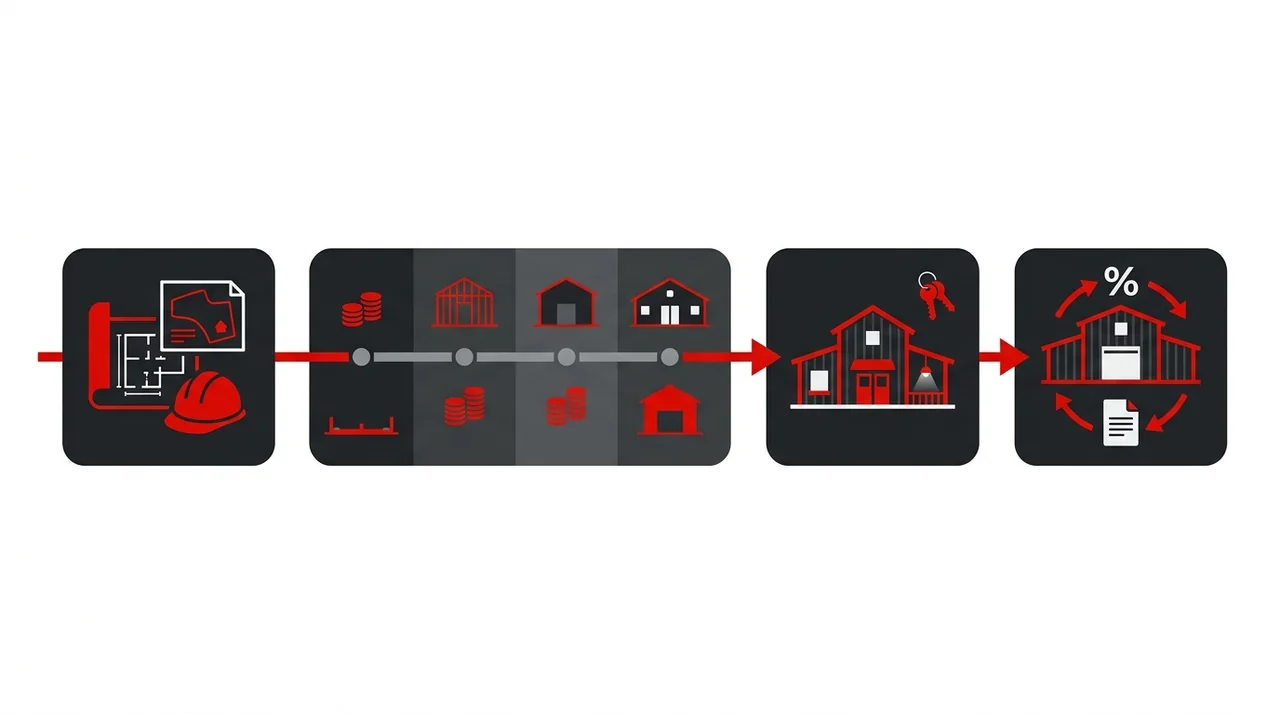
A visual reference for the comparison.
Barndominium Financing Options in Central Illinois (2026)
| Loan Type | Down Payment | Term | Best For |
|---|---|---|---|
| Construction-to-permanent | 10 – 20 percent | Single close | Most buyers |
| Two-close construction | 10 – 20 percent | Refi at completion | Community banks |
| USDA Rural Development | 0 percent | 30 year permanent | Eligible rural sites |
| VA construction (eligible vets) | 0 percent | 30 year permanent | Qualified veterans |
Cash Reserves, Contingency, and Change Orders
Every lender requires a contingency reserve, usually 5 to 10 percent of the total construction budget, held either in the loan itself or in the borrower’s cash reserves. This is not padding. It exists to absorb legitimate change orders during construction: a rock encounter on the pad, a septic upgrade a health inspector requires, or a material price move that hits a specific line item.
The homeowner controls the change orders. A disciplined builder tracks them in a written change-order log with pricing and homeowner sign-off before executing. This is where projects go over budget in Taylorville and Assumption: not because the builder cheated, but because a series of casual verbal changes stacked up over four months. Documentation is the fix.
Choosing a Local Lender That Understands Post-Frame
Not every mortgage banker in central Illinois has closed a barndominium loan. Some correspondent lenders in Sullivan still shy away from post-frame construction on their own overlays. A local community bank or credit union in Effingham, Pana, or Taylorville is often the better first call because their portfolio lending guidelines are more flexible than a national correspondent’s.
Key points to remember
Ask the loan officer directly how many post-frame construction loans they have closed in the last year. If the answer is zero, keep interviewing. The right lender saves the borrower time, money, and stress across an eight-month build. A builder like Next-Gen Buildings has working relationships with the lenders in this market and can make introductions on request.
Talk to a Central Illinois Barndominium Builder
Free pre-build consultation across Sullivan, Effingham, and Pana. We introduce you to lenders who close these loans.
Frequently asked questions
Can I finance a barndominium in central Illinois in 2026?
Yes. Regional lenders in Sullivan, Effingham, and Taylorville write construction-to-permanent loans for post-frame homes with stamped engineering and a licensed builder.
What is the minimum down payment on a barndominium loan?
Conventional construction-to-permanent typically requires 10 to 20 percent down. USDA rural development and VA on eligible sites and eligible borrowers can be 0 percent.
How long does the loan approval process take?
Pre-approval is usually one to two weeks. Full construction loan closing typically runs four to eight weeks depending on appraisal turnaround and the lender’s underwriting queue.
Do appraisers know how to value a barndominium in Illinois?
In 2026, mostly yes, especially in Sullivan and Effingham. Rural counties with few comps can still see conservative values. A builder-provided documentation packet helps.
Can I use the same loan for the land and the build?
Yes on many programs. Land is often rolled into the construction-to-permanent loan when it is purchased at closing. Existing landowners can use the equity toward the down payment.
What if my property is very remote?
Very remote sites in Paris or Shelbyville sometimes require a portfolio lender or a larger down payment because of comp scarcity. We have introductions to lenders who work these files.
Related reading from Next-Gen Buildings LLC
Written by the team at Next-Gen Buildings LLC. Serving Sullivan, IL; Effingham, IL; Pana, IL; Taylorville, IL; Paris, IL; Shelbyville, IL; Assumption, IL.
Questions? Call (217) 205-6233 or visit nextgenbuildingsil.com.